Subterranean termite treatment in Sioux Falls requires targeted mechanical defense due to regional soil dynamics and cold-weather subterranean behavior. In older neighborhoods like Cathedral Historic District,…
Subterranean termite treatment in Sioux Falls requires targeted mechanical defense due to regional soil dynamics and cold-weather subterranean behavior. In older neighborhoods like Cathedral Historic District, Pettigrew Heights, and All Saints, homes frequently feature native stone foundations, rubble walls, or unsealed basement slabs where settling cracks exceed 1/32 of an inch. Eastern subterranean termites exploit these microscopic voids from underground nesting sites below the 42-inch winter frost line, traveling inside mud shelter tubes to consume soft springwood within floor joists, sill plates, and stud framing. In newer slab-on-grade developments near Harmodon, Prairie Tree, and Silver Valley, termites bypass exterior visual detection by accessing structural timbers through plumbing penetrations and expansion joints beneath carpet or laminate flooring.
Selecting the correct mitigation strategy depends on foundation composition, soil grade, and whether active structural destruction is currently underway. A continuous non-repellent liquid soil barrier (such as fipronil applied at 4 finished gallons per 10 linear feet per foot of depth) bonds to the soil surrounding footings. Foraging termites unknowingly pass through the undetectable compound and transfer the active ingredient back to the central subterranean queen through grooming behavior, leading to complete structural colony collapse within 60 to 90 days. Conversely, an exterior bait station network installed at 10-foot intervals around the roof dripline requires zero interior slab drilling, offering long-term colony interception for historic structures or homes adjacent to water features near Riverview, Tuthill, and Country Club, where extensive trenching through established landscaping is impractical.
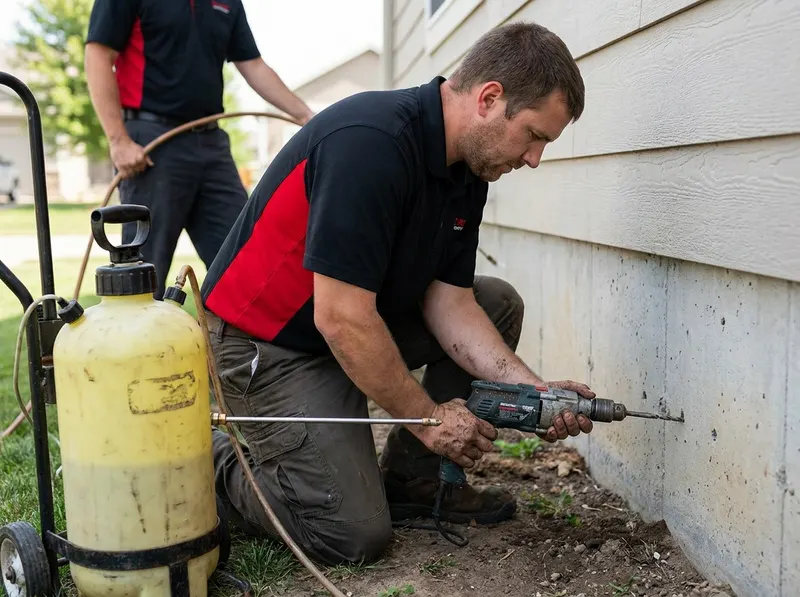
DIY topical hardware-store sprays fail against subterranean termites because surface pesticides merely kill foraging workers on contact, which alerts the subterranean colony to seal off that mud tube and construct new bypass tunnels through adjacent framing. Professional subterranean termite treatment addresses the subterranean source rather than interior surface symptoms. Concrete slab surfaces require precision drilling through mortar lines at 12-inch intervals to inject protective barriers directly beneath expansion joints, followed by color-matched masonry patching. Exterior soil along foundation perimeters is opened via a 6-inch by 6-inch trench, treated, and backfilled with treated soil to establish continuous protection that withstands high clay moisture expansion along the Big Sioux River basin.
Every job gets a firm, written price after a free on-site visit.
Tell us about your subterranean termite treatment job in Sioux Falls and we'll send a clear, written quote, usually the same day.
 Solvian Bug Removal