Exterior perimeter defense serves as a targeted physical and chemical buffer that halts invasive pests without saturating indoor living spaces with synthetic residues. In mature neighborhoods like All Saints, Pettigrew…
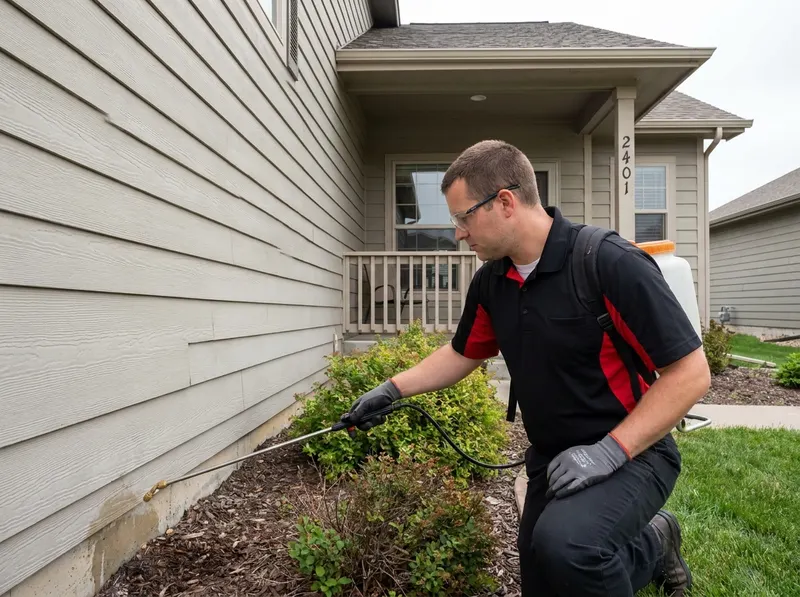
Exterior perimeter defense serves as a targeted physical and chemical buffer that halts invasive pests without saturating indoor living spaces with synthetic residues. In mature neighborhoods like All Saints, Pettigrew Heights, and the Cathedral Historic District, century-old fieldstone and poured foundations develop micro-fissures, while dense boxelder and elm canopies drop organic matter that feeds spider and ant populations. In newer eastern and southern developments around Harmodon, Prairie Tree, and Silver Valley, extensive grading shifts field ants and ground spiders toward freshly poured concrete slabs. An exterior barrier neutralizes these vectors by treating entry points, such as basement window wells, weep screeds, crawlspace vents, and sill plates, rather than applying broad indoor sprays that disrupt family routines.
Selecting a dedicated exterior barrier over whole-home broadcast spraying depends on property biology and occupant preferences. When ant trails or spiders appear strictly along baseboards, entry doors, or siding lines, treating the exterior envelope halts recruitment pheromones at the source; the trade-off is that existing indoor satellite nests may require isolated gel baiting rather than relying solely on perimeter deterrence. Homeowners with pets benefit because microencapsulated exterior compounds bind tightly to soil, stone, and brick within 60 minutes of drying, presenting negligible transfer risk compared to generic indoor aerosol drenching. Unlike store-bought perimeter jugs that degrade after 48 hours of ultraviolet radiation, commercial exterior formulations maintain active surface tension across variable South Dakota temperature swings.
Application follows a methodical three-step mechanical and residual protocol. First, technicians inspect the foundation perimeter, measuring foundation clear zones and removing spider egg sacs and webbing from fascia boards, soffits, and exterior lighting fixtures up to 16 feet high. Second, a continuous chemical barrier is applied using a low-drift, coarse-droplet spray rig across the lower 36 inches of exterior siding and masonry, extended 36 inches out across ground surfaces. Third, technicians apply water-resistant granular bait around exterior air conditioning pads, hose bib penetrations, and landscape retaining walls to intercept colony foraging trails before workers access primary structural thresholds. This approach avoids recurring contract lock-ins by resolving pest pressure at exterior transit corridors.
Every job gets a firm, written price after a free on-site visit.
Tell us about your exterior spider and ant barrier job in Sioux Falls and we'll send a clear, written quote, usually the same day.
 Solvian Bug Removal